Posts

Free Music-Adventures of Superball

I've had a few people request a written version of my tune Adventures of Superball . So, for those who are interested, you can download a copy here . There are two versions one for guitar and one for mandolin. This tune is on my latest CD, Open Spaces . You can purchase the track, Adventures of Superball and the rest of the CD below. Have fun with it!

The Blues Shuffle

Here's a free lesson on playing the blues shuffle. If you've never played the blues before, you'll want to check this out. It's a great place to get started! Click here to go to the All 12 Notes site and view the lesson. To view it you'll need the Scorch plug-in, available from Sibelius (click here for the plug-in) . If you would like to spend a week with me learning the blues, I'll be teaching at the Chicago campus of the National Guitar Workshop , from July 12-17. The workshop has great teachers, great students, and awesome guest artists. Pamper yourself and sign up for a week of nothing but guitar!

Practice Toolbox-The Metronome

Playing in time, with a good time feel, is a must for every musician regardless of the style you choose to play. If your time feel is solid, then people with want to play with you and you will be an asset to any group. The Metronome The tool that helps us develop a solid time feel is a metronome, so let's add it to our toolbox! A metronome is a device that generates a short sound at a specified tempo or speed. Many have a dial you turn to adjust the tempo, others have buttons that increase or decrease the tempo. Choosing a Metronome Metronomes all work pretty much the same way. Some have a needle that moves back and forth, others a digital needle on a display, and a few simply have a light that blinks with every click. They vary in price and size. One thing to check out before buying, is the sound. Some metronomes generate a beep and others have a wood block sound. I've had students comment that the beep becomes annoying after a while and that the wood block is less gr...

The Practice Toolbox

Welcome to the start of a new series entitled the "Practice Toolbox." Every great carpenter has a toolbox stocked with tools that are necessary to get the job done. We as musicians need to have a toolbox filled with the necessary items to practice effectively and efficiently. In the posts to follow I will suggest some of the tools I use and how to effectively use them in a practice session. To start, we need a place to put all of our tools. If you haven't already done so, pick a place that will become your practice space. This is where you'll keep all of your tools. Having a centralized practice space will help to minimize excuses and maximize productivity. The space doesn't have to be large or fancy; it could simply be a corner in your bedroom. Try to pick a space that will have few distractions. When you step into your space you want to get into practice mode and the more distractions the harder it is to get into that practice mode. Here are a few pract...

Playing through Changes with Digital Patterns

At the last All 12 Notes Swing Jam , the topic of Digital Patterns came up as technique for navigating chord changes. Digital patterns are easy to implement and are great for getting the sound of individual chords and chord progressions in your ear. They're also good technical studies. What's a Digital Pattern? Simply put, a digital pattern is a specific sequence of notes. The major scale could be considered a digital pattern: 1, 2, 3, 4, 5, 6, 7, 8. Here's the first digital pattern I was introduced to as I began my journey into jazz improvisation: 1, 2, 3, 5. This four note sequence is created by taking the 1, 2, 3, and 5th notes of the major scale. Application If I were in the key of C the notes of the 1, 2, 3, 5 pattern would be C, D, E, and G-notice the pattern has a C triad in it. It can be applied to the major family of chords, for example: C, C6, C7, Cmaj7. What if I'm confronted with chords of the minor family? To adjust the pattern to fit the minor chord...
Learning the Notes on the Fingerboard

Image
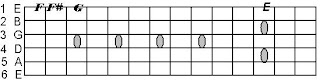
One of the best pieces of advice I received from a former instructor during my developing years was, "You need to know every note on the fingerboard." This seemed like a daunting task to say the least. But this instructor was right on! It's incredibly helpful to know the names of every fret on every string. So let's look at what it takes to accomplish this task. Open Strings To start, you must know the open strings of the guitar. From strings 6 (lowest) to 1 (highest) the notes are as follows: E, A, D, G, B, E. By memorizing these notes you now have a home base to work from for figuring out the remaining notes. Musical Alphabet and Natural Half-Steps The musical alphabet is made up of 7 notes: A, B, C, D, E, F, and G. When you reach G you wrap back around to A. The distance between each pair of adjacent notes is fixed. For example the distance between A and B is a whole-step and on the guitar a whole-step is 2 frets. There are two pairs of notes that are a h...